
Greenwood Property Records
Greenwood property records are filed and stored with the Johnson County Recorder's Office, which serves as the official keeper of all recorded real estate documents in the county. Deeds, mortgages, liens, plats, easements, and similar instruments tied to Greenwood land are part of this public record system. Residents, buyers, sellers, and researchers can access these records in person, by mail, or through online search tools. This page covers how to find Greenwood property records and what to expect when you request or record a document.
Greenwood Property Records
Johnson County Recorder - Greenwood Area Records
The Johnson County Recorder handles all property document recording for Greenwood. You can reach the office by phone at (317) 736-3718. The Johnson County Recorder's website has contact information, hours, and links to the document search system. The office is in Franklin, the county seat, but serves all property owners in Johnson County including those in Greenwood.
The Johnson County Recorder indexes documents by grantor and grantee name, document type, and recording date. Once a document is recorded, it becomes part of the public record and can be searched by anyone. The county's document center at johnsoncounty.in.gov provides access to a range of recorded instruments. Many recent filings are available as digital images you can view or download.
Recording fees are set by state law. A deed costs $25. A mortgage is $55. Other documents such as releases and affidavits are $25 each. Certified copies cost an additional $5 on top of the standard copy rate. Paper copies of standard-size documents run $1 per page.
The image below shows the City of Greenwood official website, which links to city services and can help you identify relevant city departments alongside the county recorder.
The City of Greenwood site provides access to local government services and links to Johnson County resources for property owners.

The city and county work together on property matters, and the city site can point you toward the right county office when you have questions about your parcel.
Search Greenwood Property Records Online
Online access to Greenwood property records is available through several platforms. The Johnson County Recorder's document center is the most direct route for recorded instruments. For broader property data, Doxpop aggregates recorded documents from Johnson County and indexes them for easy searching by name or parcel. Both free and subscription options are available on Doxpop.
The DLGF assessed value search lets you look up the current assessed value for any Greenwood parcel. The Department of Local Government Finance maintains this tool and updates it based on county assessor data. It is useful if you want to check how a property is valued for tax purposes before or after a transfer.
The Indiana Gateway portal also provides links to county fiscal data, tax bills, and other property-related information. These tools work alongside the Recorder's document search to give you a complete view of a property's recorded history and current tax status.
Recording Property Documents in Greenwood
To record a deed or other property document in Greenwood, you bring it to the Johnson County Recorder's Office in Franklin. Before it reaches the Recorder, the document must first be reviewed by the County Assessor and then endorsed by the County Auditor. This three-step process is standard across Indiana. Fees are collected at both the Auditor's and the Recorder's offices.
All documents must meet Indiana's formatting standards. White paper is required, with a minimum weight of 20 pounds and a maximum size of 8.5 by 14 inches. Font must be at least 10-point and printed in black ink. The first page needs a 2-inch top margin. Names must be typed or printed below each signature exactly as they appear in the signature. Every document needs a "Prepared by" line, and all Social Security numbers must be removed under IC 32-21-2 before submission.
Johnson County accepts electronic recording for many document types. E-recording vendors including CSC eRecording (866-652-0111) and Simplifile (800-460-5657) can process your submission without a trip to the courthouse. Confirm with the Recorder's office which document types are accepted electronically before using this method.
A Sales Disclosure Form is required whenever a deed is recorded. This form is submitted to the Auditor as part of the transfer process and triggers the update to the county's ownership records. Without it, the Auditor will not endorse the deed, and the Recorder will not record it.
Greenwood Land Records and Deed History
Greenwood has grown substantially over the past few decades as part of Indianapolis's southern suburban expansion. The Johnson County Recorder holds a dense index of deeds and plats reflecting that growth. If you need to trace the ownership history of a Greenwood property, the Recorder's index is where to start. Searches can go back many decades, and older records may also be available through the Indiana State Archives.
Plat maps for Greenwood subdivisions are recorded with the Johnson County Recorder. These maps establish lot lines, road widths, and easements within each development. They are public records. You can view them through the Recorder's online portal or request paper copies. Plat maps are essential when you need to understand the boundaries and restrictions that apply to a specific lot.
Greenwood Property Tax Records
Tax records for Greenwood parcels are held by the Johnson County Assessor and Auditor. The Assessor determines the assessed value; the Auditor computes the annual tax bill. Both sets of data are public. You can search current and past tax records through the DLGF Tax Bill Search or through the county's own portal.
The assessed value search through the DLGF is shown in the screenshot below, which illustrates how property owners can check their parcel's valuation online without visiting the county offices.
The DLGF assessed value tool is maintained by Indiana's Department of Local Government Finance and pulls data from county assessors statewide.
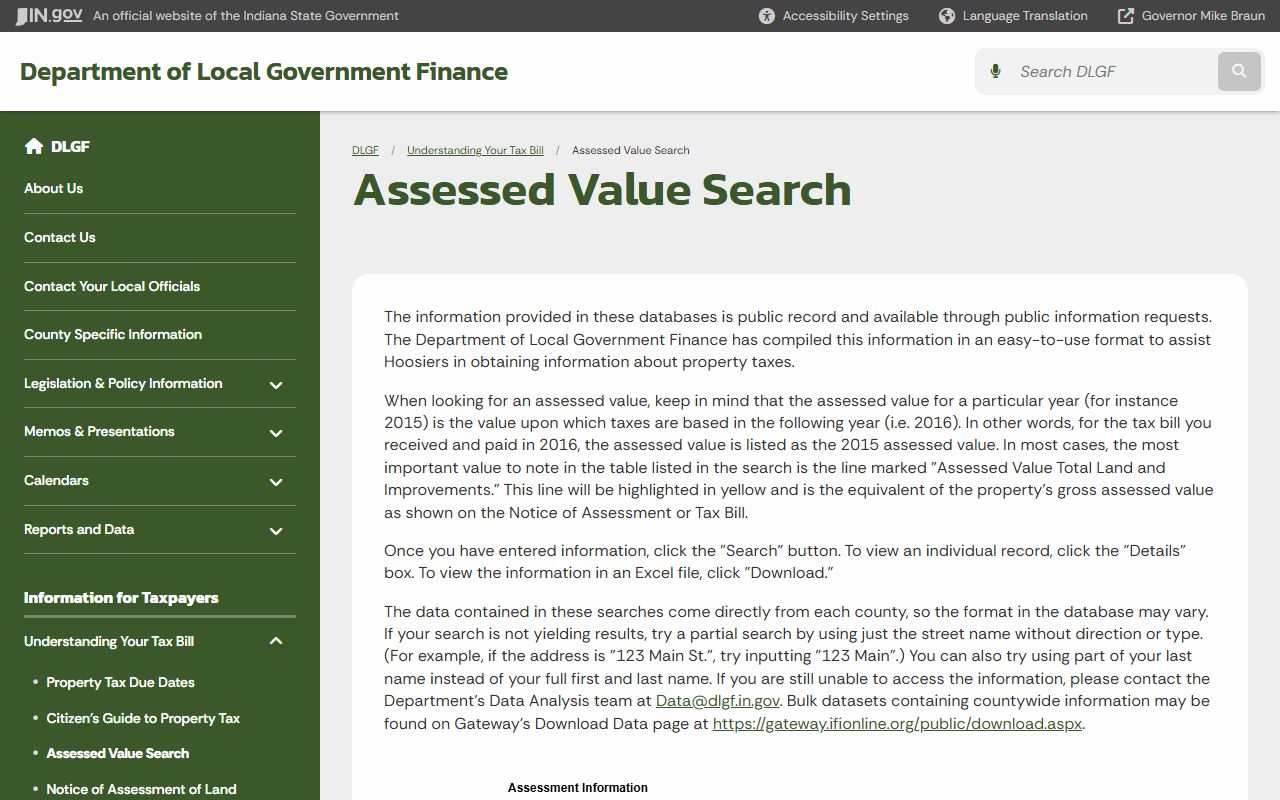
Property owners can use this tool to verify their current assessed value before the annual tax bills are issued by the county.
Tax lien certificates and delinquent tax records are also public. If a Greenwood property has unpaid taxes, that information will appear in the county's records. This can matter a great deal in a real estate transaction, since tax liens run with the property and not the owner.
State Resources for Greenwood Property Records
Beyond the Johnson County Recorder, several Indiana state agencies maintain property-related records that cover Greenwood. The Indiana Recorders Association lists all 92 county recorder offices and provides links to available online tools. It is a useful starting point when you need to reach a specific office or find out what records are available electronically.
Indiana law under IC 36-2-11 sets out the duties of county recorders, including the obligation to record all qualifying instruments and make them available as public records. The statute also governs fees, indexing requirements, and document rejection criteria. Understanding the law helps you prepare documents correctly the first time.
For property tax assessment rules, IC 6-1.1 is the governing statute. It covers how properties are assessed, how owners can appeal valuations, and the timeline for the annual assessment cycle.
Note: If you are searching for older Greenwood real estate records that predate the county's digital index, contact the Johnson County Recorder's Office directly to ask about microfilm or paper record access.
Nearby Indiana Cities
Greenwood is in Johnson County on Indianapolis's southern edge. Several nearby cities share the same metro area and use adjacent county recorders for their property documents.