
Search Indiana Property Records
Indiana property records are public documents held by the County Recorder's Office in each of the state's 92 counties. These records cover deeds, mortgages, liens, easements, subdivision plats, and other instruments that affect real property ownership. Whether you need to trace a chain of title, check for liens on a parcel, look up assessed values, or find a recorded deed, Indiana makes these records open to the public. You can search them online through county portals and statewide databases, request copies by mail, or visit a recorder's office in person.
Indiana Property Records Quick Facts
Where Indiana Property Records Are Kept
The County Recorder is the primary keeper of property records in Indiana. Each of the state's 92 counties has its own Recorder's Office, created as a constitutional office under Article 6, Section 2 of the Indiana Constitution. Under IC 36-2-11, the recorder receives, indexes, and stores documents that affect real property. That includes deeds, mortgages, liens, releases, easements, UCC filings, subdivision plats, military discharges, articles of incorporation, and several other document types. All of these are public records open to anyone who wants to look.
Recording a deed in Indiana is not a one-stop process. Before a deed ever reaches the Recorder's Office, it must first be reviewed and stamped by the County Assessor's Office, then transferred through the County Auditor's Office. Only after both steps can the recorder accept the document and enter it into the official record. This flow exists so that the state captures the property transfer for tax purposes. Bring payment for both the auditor and recorder when you submit a deed, because each office may collect its own fees. The auditor in some counties accepts only cash or checks, while the recorder may take credit cards with a convenience fee.
Records are indexed alphabetically by grantor and grantee name under IC 36-2-11-12, with separate indexes for deeds and mortgages. New documents typically appear in online systems within 24 hours of the recording date, though that varies by county.
The Indiana Code covering county recorders details the full scope of what each Recorder's Office must accept, record, and maintain for the public.
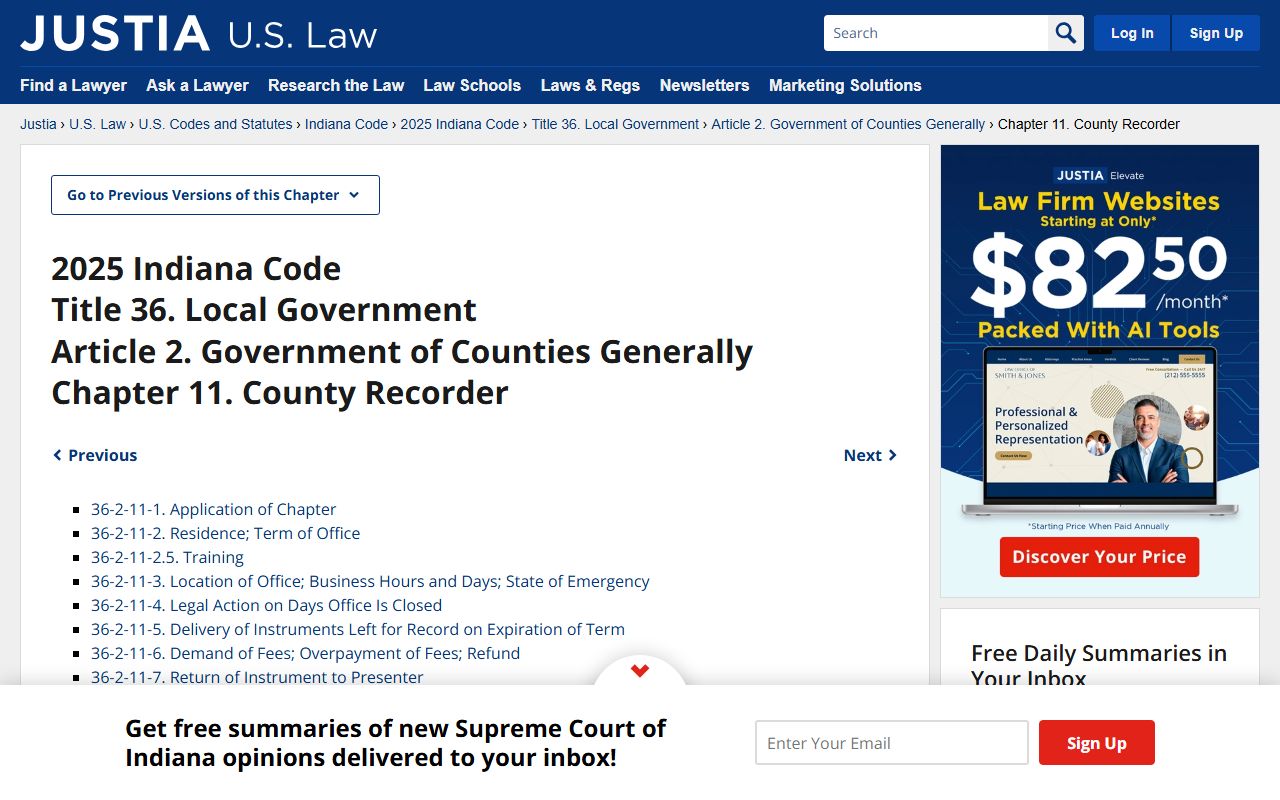
IC 36-2-11 defines the duties of every county recorder in Indiana, including what documents must be recorded, how they must be indexed, and how records must be stored for long-term public access.
Indiana State Archives and Land Office
The Indiana State Archives holds historical land records that go back to Indiana's territorial period. The collection includes original land entries and sales from the six federal land offices that operated in Indiana starting in 1804. Those offices were located in Vincennes, Jeffersonville, Brookville, Terre Haute, Fort Wayne, and LaPorte. The archives maintain General Land Office plat maps, federal land office indexes, and Native American land records tied to treaties and land cessions. If you are researching early Indiana land ownership or need records from before organized county government, this is the right place to start. The archive is at 6440 E. 30th Street in Indianapolis and can be reached at (317) 591-5222.
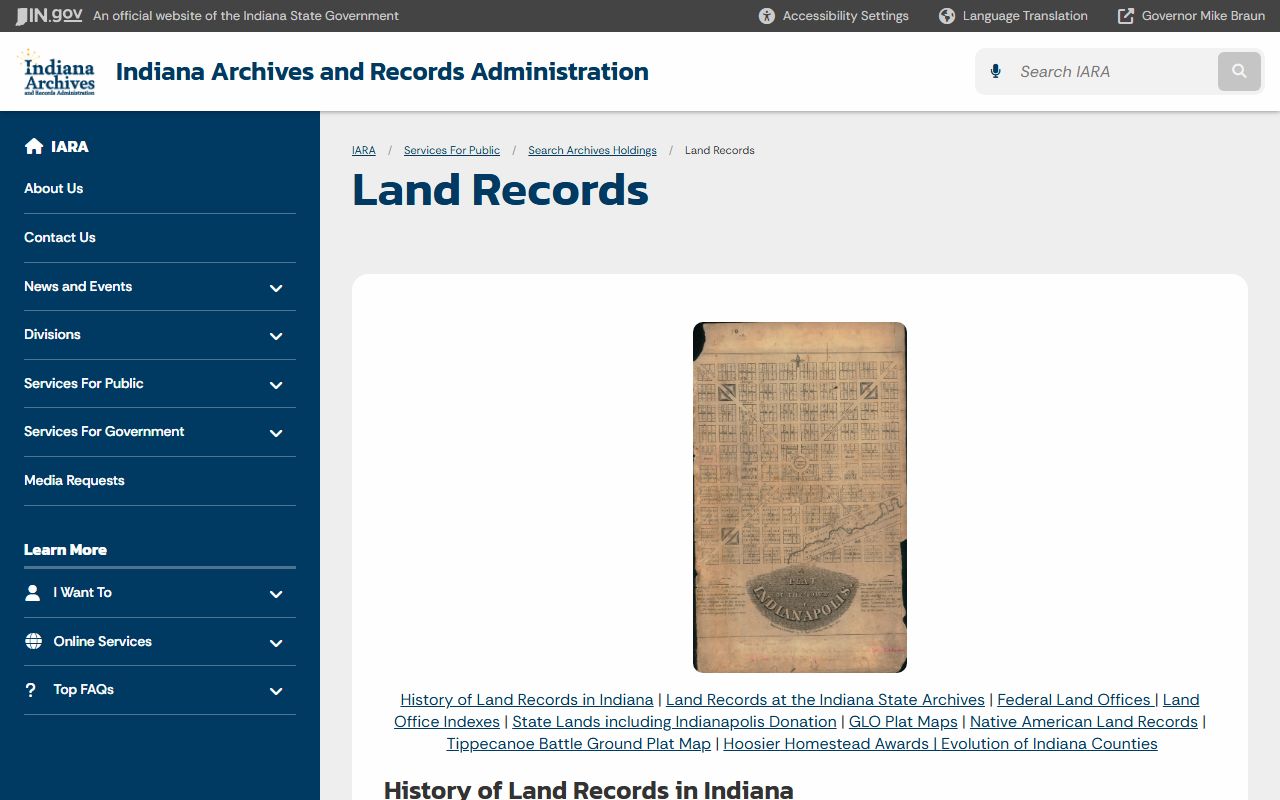
The State Archives collection also includes Hoosier Homestead Awards for century and sesquicentennial farms, making it useful for families tracing long-held agricultural land in Indiana.
The Indiana State Land Office is a separate resource, open by appointment only. It is located at 402 West Washington Street, Room W-264, Indianapolis, IN 46204. Call (317) 232-3787 to schedule a visit. This office maintains more than 7,500 deeds and draft overview maps for land previously or currently owned by the state. Indiana's state government owns approximately 425,000 acres, which is about 1.8% of the state's total land area. The office uses GIS mapping to track state-owned properties and handles easements, policy questions, and surplus real estate. Note that state highway right-of-ways are kept by the Indiana Department of Transportation, and university property records stay at each university under IC 14-18-1.5.
Online Property Records Databases in Indiana
The Indiana Gateway Tax Bill Lookup lets you search property tax bills statewide by taxpayer name, address, parcel number, or taxing district. The tool is free and available to anyone.
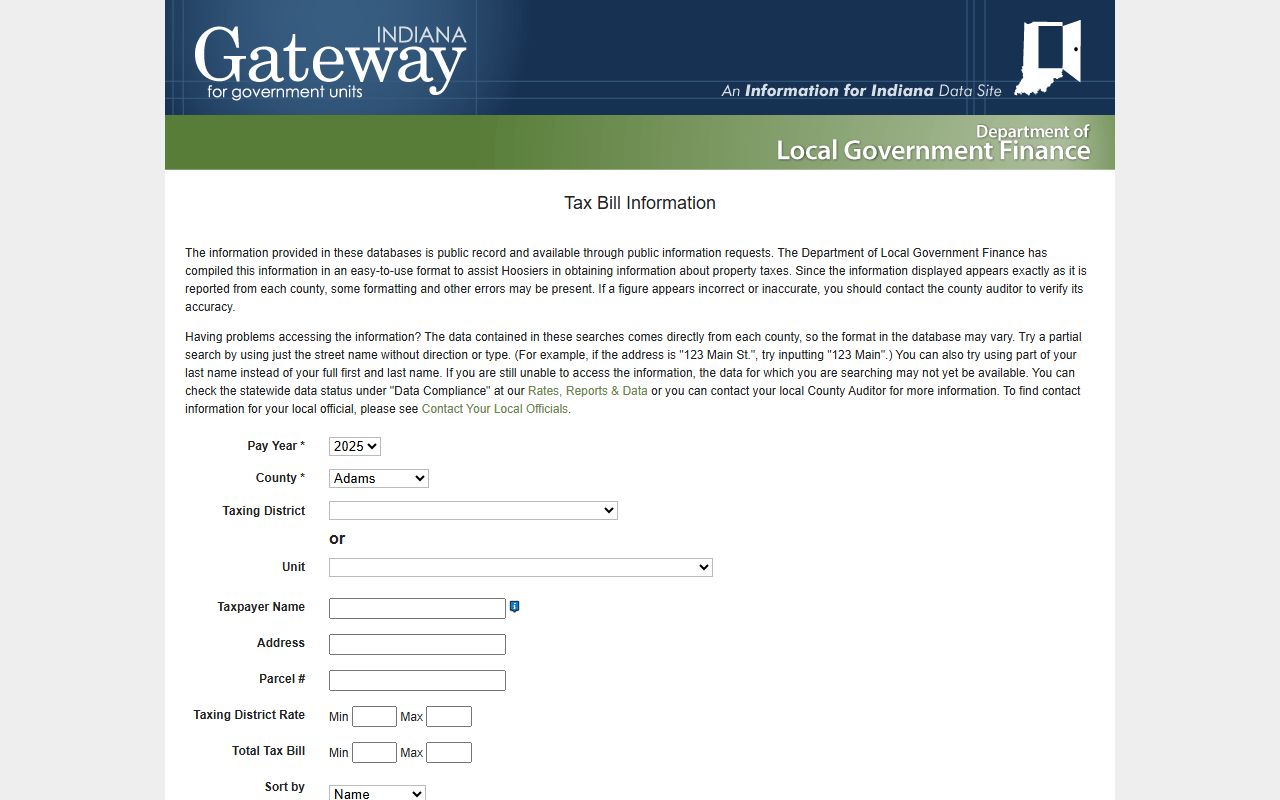
The Gateway tool pulls data directly from each county, so format may vary. If a figure looks wrong, the Department of Local Government Finance recommends contacting the county auditor to verify, since data is reported exactly as received from local sources.
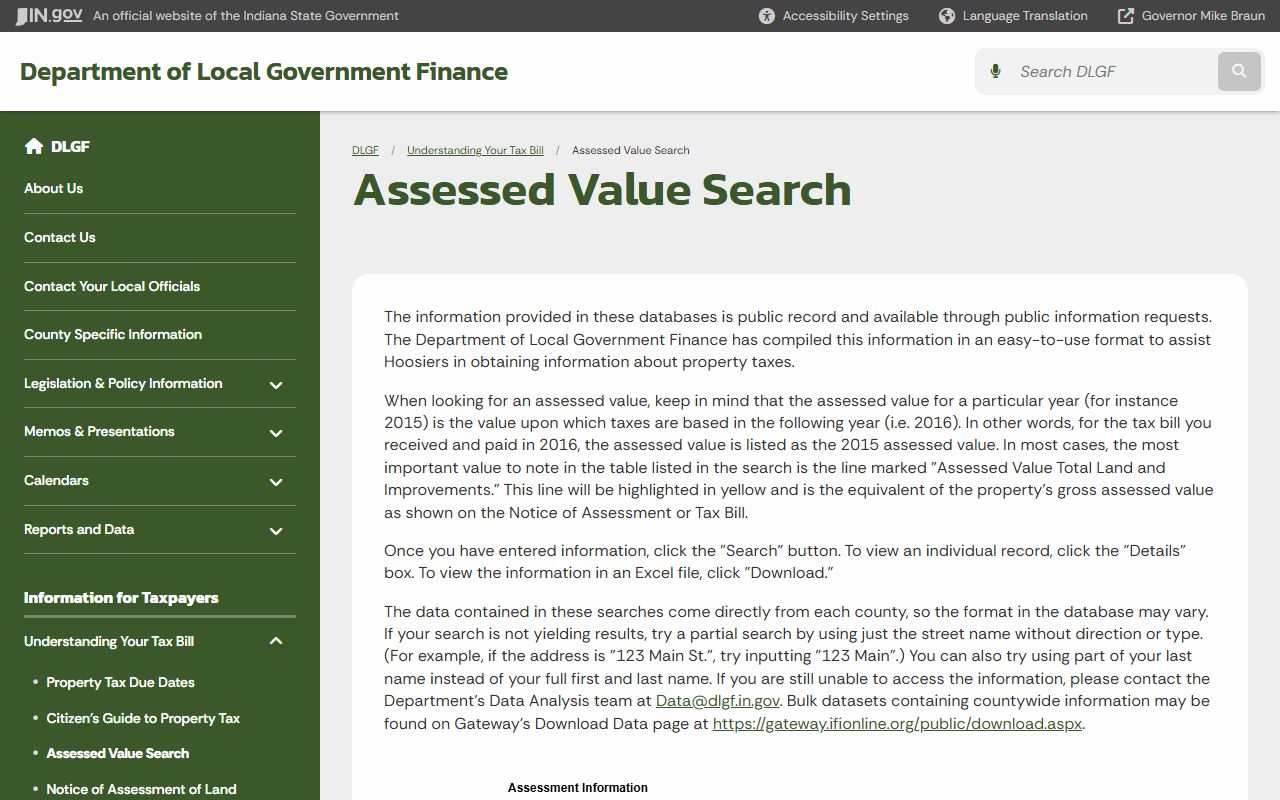
The Department of Local Government Finance (DLGF) runs a statewide database at in.gov/dlgf. You can search by pay year, county, taxpayer name, address, or parcel number. The DLGF also runs an Assessed Value Search at in.gov/dlgf/assessed-value-search. When using this tool, keep in mind that the assessed value for a particular year is the basis for taxes in the following year. The line to look for is "Assessed Value Total Land and Improvements," which is highlighted in yellow and matches the gross assessed value on your tax bill or Notice of Assessment. Data can be downloaded in Excel format. For bulk datasets, contact Data@dlgf.in.gov or visit the Download Data page at gateway.ifionline.org.
The DLGF Assessed Value Search makes it easy to compare multiple parcels and spot differences in assessment across neighborhoods or taxing districts.
Assessment appeals in Indiana go through the Property Tax Assessment Board of Appeals (PTABOA) in each county, with the county assessor serving as secretary under IC 6-1.1. Approximately 25% of parcels are physically inspected each year on a four-year rotation.
The main Indiana Gateway for Government Units portal brings together tax bill lookup, assessed value search, and other public finance tools in one place. You can also find a Referendum Impact Calculator here that shows how school funding referendums affect property taxes based on assessed value.

Gateway pulls live data from all 92 Indiana counties, so results are as current as each county's reporting cycle allows.
Indiana County Recorder Online Access
The Indiana Taxpayer Portal on Gateway consolidates tools for looking up bills, checking assessed values, and understanding local tax impacts without navigating individual county websites.
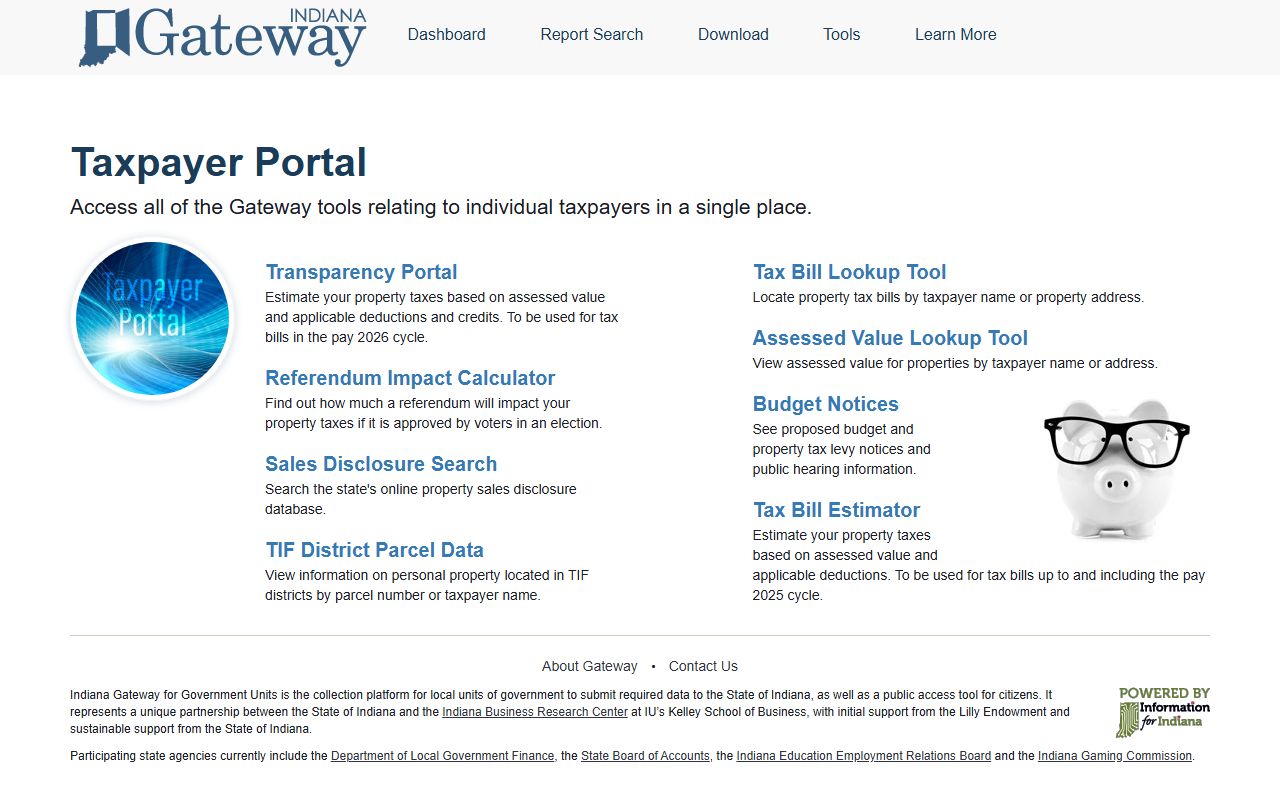
The portal is free to use and covers all Indiana counties, making it a good starting point before going deeper into individual county recorder systems.
Most Indiana counties partner with private vendors for online document searching. The most common platforms are Doxpop, Laredo (Fidlar Technologies), Tapestry, XSoft Engage, and Beacon/Schneider. Each has its own pricing model. Laredo, used by Hamilton County and others, offers monthly subscription packages starting at 100 minutes per month up to unlimited use. It charges $1.00 per printed page with no per-document fee just to view. Tapestry, also available in multiple Indiana counties, charges $8.75 per search and $1.00 per printed page, but lets you view all documents in a search at no extra cost. Doxpop serves a large number of Indiana counties and also provides a free Property Watch email alert service. Many counties also offer a free limited search through the county's own website before requiring a subscription for full document access.
The Indiana Recorders Association represents all 92 county recorders across the state. Their website has links to individual county offices and guidance on recording standards.
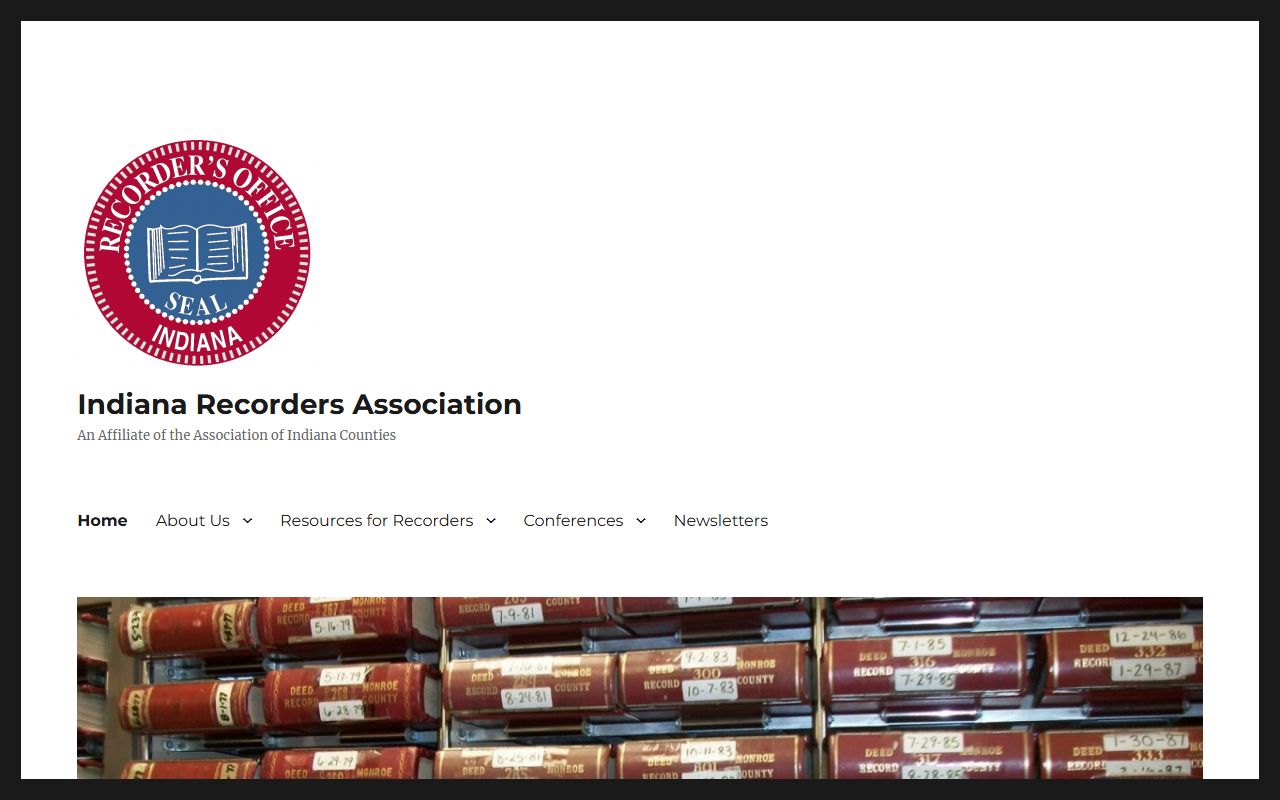
The Association is a useful starting point if you need to locate a specific county recorder or want to understand how property records are managed across Indiana's different counties.
How to Record Indiana Property Records
Indiana sets clear standards for how documents must be prepared. Under IC 36-2-11-16, all documents must be notarized, and names must be typed or printed under each signature exactly as signed. Paper must be white, no larger than 8.5 by 14 inches, and must weigh at least 20 pounds. Top and bottom margins on the first and last pages must be at least two inches. Side margins must be at least half an inch. Font must be at least 10-point type, printed in black ink. Documents that do not meet these formatting rules may be charged an extra $1 per non-conforming page.
Every document affecting real property must include a legal description of the land. Deeds must list the grantee's mailing address. A "prepared by" statement is required on all recorded documents. Under IC 32-21-2, Social Security numbers must be redacted unless the law specifically requires them. When submitting a deed, a completed Sales Disclosure form is required, which the Auditor's Office reviews before recording can proceed.
Recording fees are set by state law. Deeds cost $25 to record. Mortgages cost $55. Affidavits and other documents cost $25. Each release or assignment is $25. Oversized pages that exceed 9 by 15 inches are charged $5 per page. Standard copies are $1 per page for sizes up to 11 by 17 inches and $5 per page for larger formats. Certified copies add $5 to the base copy cost.
E-recording is widely available across Indiana through vendors like CSC eRecording (866-652-0111), Simplifile (800-460-5657), and eRecording Partners Network at 888-325-3365. Contact your county recorder to confirm which e-recording services they accept before submitting remotely.
Note: Some counties accept payment only by cash or check, while others take credit cards with a convenience fee. Confirm payment methods with the specific county office before you submit documents.
Protecting Your Indiana Property Records
Property deed fraud is a real problem in Indiana. Several county recorders now offer free fraud alert programs that send email notifications whenever a document is recorded in your name or tied to your property address. Doxpop's Property Watch service is available through many Indiana counties at no charge. Equity Protect offers another free monitoring option in some counties. Allen County reported over 18,000 new sign-ups in 2025 alone, with more than 55,000 total participants enrolled in its fraud alert program. Hendricks County offers Property Watch through Doxpop and sends email alerts immediately when a matching document is filed. These programs will not prevent fraud, but they can alert you quickly so you can take action before things get worse.
If you receive a suspicious letter about deed processing, call your county recorder before responding or sending money. Hancock County issued a public notice warning about mail scams targeting property owners with official-looking notices. A copy of your recorded deed is available from the Recorder's Office for just $1 per page, so you should never need to pay a third party for basic record access. Check your recorded documents periodically and report anything that looks wrong to the recorder's office and local law enforcement.
Indiana Property Records by County
Property records in Indiana are maintained at the county level. Each of Indiana's 92 counties has its own Recorder's Office with its own contact info, fees, and online search tools. Pick a county below to find local resources for property records in that area.
Indiana Property Records by City
Cities in Indiana do not maintain their own deed or mortgage records. All property filings go through the county recorder for the county where the property sits. Use the links below to find county property record resources for major Indiana cities.