
Search Clark County Property Records
Clark County property records cover all real estate transactions in the Jeffersonville area and the surrounding communities along the Ohio River. The County Recorder's office at 300 Corporate Drive in Jeffersonville is the primary keeper of recorded instruments, and it has been so since the Indiana Constitution established the Recorder position in 1816. Deed index records are available online back to November 1999 through the XSoft Engage property database. The office processes documents in a specific three-step flow involving the Assessor, Auditor, and Recorder. This page explains how to search Clark County land records and what to expect when you need to file or retrieve a recorded instrument.
Clark County Property Records
Clark County Recorder's Office
The Clark County Recorder is at 300 Corporate Drive, Jeffersonville, IN 47130, Room 102. You can reach the office by email at sgill@clarkcounty.in.gov. The Recorder's website is at co.clark.in.us. The County Recorder was one of the first offices created by the Indiana Constitution in 1816, making it one of the oldest public record offices in the state. The Recorder is elected to a four-year term with a two-term limitation.
The primary duty of the Clark County Recorder is to record instruments submitted for recording and to maintain those records permanently. This means every deed, mortgage, lien, assignment, and release filed against real property in Clark County becomes part of the official record the moment it is recorded. Under IC 36-2-11, the Recorder must index, store, and preserve all of these instruments so they remain accessible to the public indefinitely.
There are a few important things to know before visiting the Clark County Recorder's office. Staff will not search public records for you. That is your job, not theirs. Staff also will not give legal opinions about any document. You use the public access computers or online services to do your own research. This is standard practice in most Indiana recorder offices and is a reflection of the volume of requests they handle. Come prepared with the names and parcel numbers you need.
The Clark County Recorder's official website shown below provides information on recording fees, e-recording options, and the online search tool for Clark County property records.
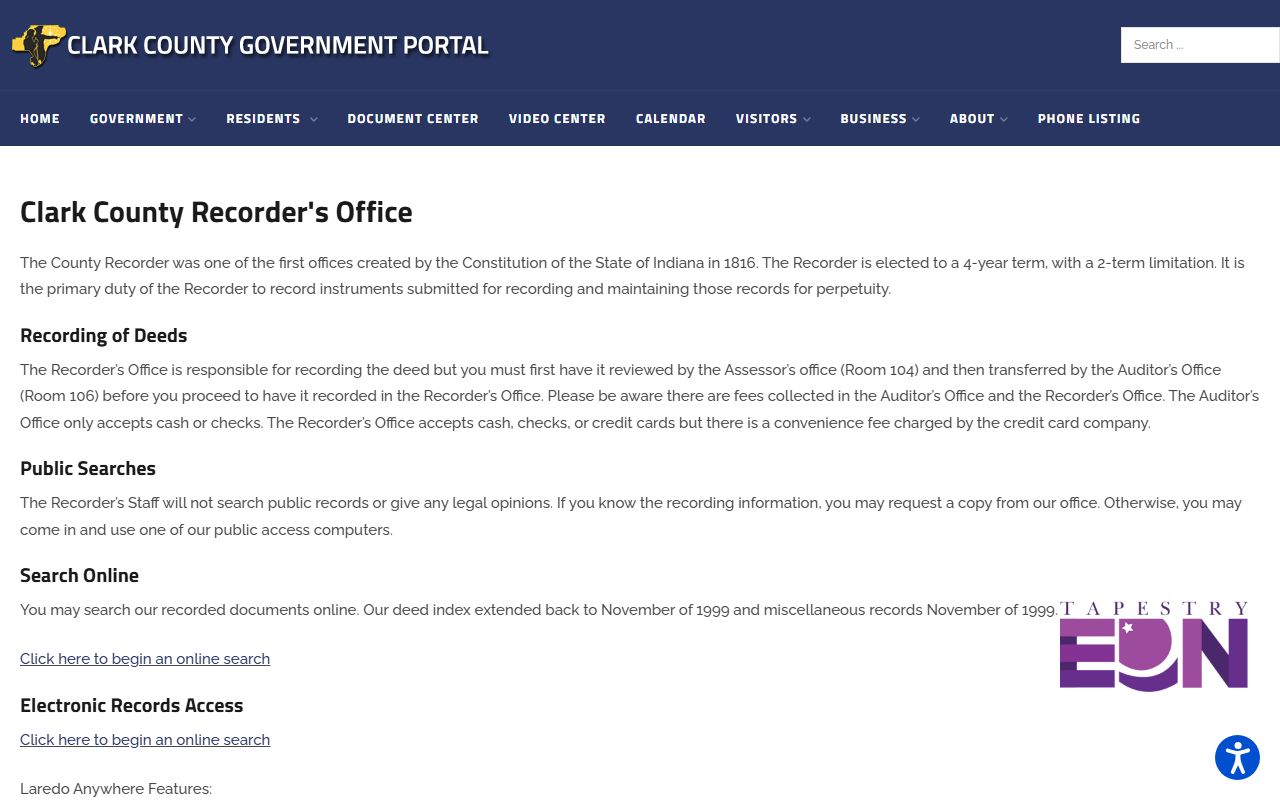
From this page you can find the Recorder's contact information, recording fee schedule, and links to the XSoft Engage online search system for Clark County recorded documents.
Search Clark County Recorded Documents Online
Clark County uses the XSoft Engage property database for online access to recorded instruments. The search tool is available at engage.xsoftinc.com/clark. Deed index records go back to November 1999, and miscellaneous records also go back to November 1999. This covers most of the modern recording history for Clark County parcels. For older documents filed before November 1999, you will need to visit the courthouse and search the physical index books or request copies directly from staff.
A Laredo Anywhere subscription is available for users who need regular, high-volume access to Clark County recorded documents. Laredo is a professional-grade tool commonly used by title companies, lenders, and attorneys. It provides full document images and a more robust search interface than the basic XSoft Engage tool. Contact the Recorder's office for information on setting up a Laredo subscription.
The XSoft Engage online property search for Clark County is shown below, which lets you search recorded instruments by name, document type, and date range.
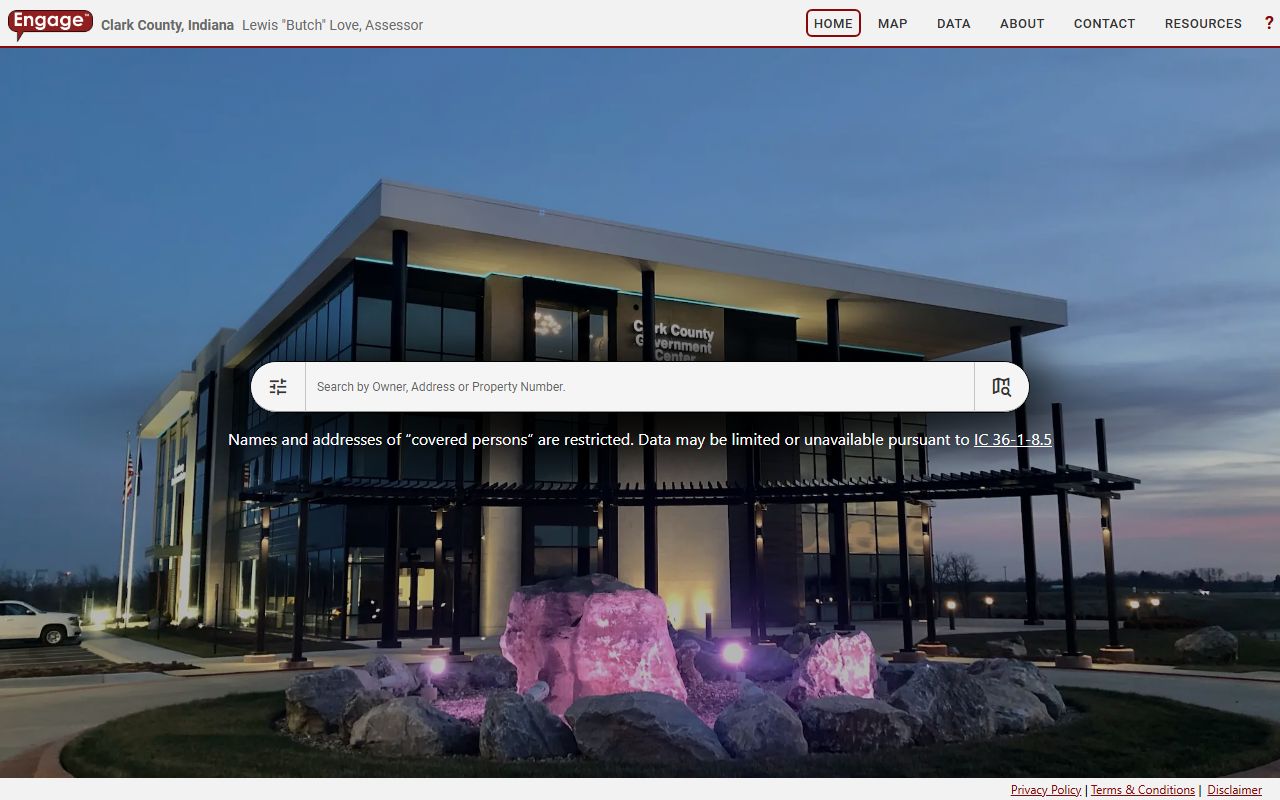
Use XSoft Engage to pull Clark County deed index records, mortgage filings, and miscellaneous instruments recorded since November 1999 without visiting the courthouse.
For older Clark County records and historical land grants, the Indiana State Archives land records portal covers documents that go back to the early 1800s. The Doxpop platform also covers Clark County recorder data and may provide an alternative search interface with different indexing options.
Note: The Clark County Recorder's office has public access computers on-site for in-person searches. Staff will direct you to those terminals but will not conduct searches for you.
The Clark County Recording Process
Clark County follows a specific three-step process for recording deeds and other real property instruments. Understanding the flow before you go can save you a trip back. The document first goes to the Assessor's office in Room 104 of the building at 300 Corporate Drive. The Assessor reviews the deed and stamps it. Then it goes to the Auditor in Room 106 for transfer and endorsement. Finally it reaches the Recorder in Room 102 for official recording.
Payment works differently at each step. The Auditor's office accepts cash or checks only. The Recorder's office accepts cash, checks, or credit cards, though a convenience fee applies for card payments. Have cash or a check ready for the Auditor step. For the Recorder step, any of those payment methods works. A Sales Disclosure form must accompany the deed when you submit it to the Assessor at the start of the process.
Documents submitted to the Clark County Recorder must comply with all Indiana recording requirements. Everything must be notarized. Names must be typed or printed under each signature exactly as signed. A "Prepared by" statement is required. Paper must be white, no larger than 8.5 by 14 inches, with minimum 20-pound weight. Margins on the first and last pages must be at least 2 inches top and bottom, with half-inch minimums on all sides. Font must be 10-point minimum in black ink. Social Security numbers must be fully redacted per IC 32-21-2. Non-conforming documents are charged an extra $1 per non-conforming page.
E-Recording and Fees in Clark County
Clark County accepts e-recording through four vendors. CSC eRecording is available at 866-652-0111. ePN (eRecording Partners Network) can be reached at 888-325-3365. Indecomm is also accepted. Simplifile is available at 800-460-5657. Electronic filing is common for title companies, lenders, and law firms that submit documents regularly. It speeds processing and reduces the risk of documents being rejected for formatting issues, since e-recording platforms typically check requirements before submission.
Recording fees in Clark County follow Indiana's statewide schedule. Deeds cost $25. Mortgages are $55. Affidavits and other instruments are $25 each. Releases and assignments run $25 each. Pages that exceed 9 by 15 inches add $5 per page. Standard copies cost $1 per page, larger copies cost $5 per page, and certified copies add $5 to the copy fee. These fees apply whether you file in person or through an e-recording vendor.
Property Tax and Assessment in Clark County
Assessed values for Clark County parcels are set by the County Assessor under IC 6-1.1. The state's DLGF Assessed Value Search lets you look up the current assessed value for any Clark County parcel at no cost. Tax bill information is available through the DLGF Tax Bill Search and the Indiana Gateway Taxpayer Portal, both of which are free state tools updated regularly. For owners who want to appeal an assessment, contact the Clark County Assessor's office before the deadline shown on your notice.
The Indiana Recorders Association also serves as a resource for property owners and professionals navigating Indiana's recording system. If you have questions about what the Clark County Recorder requires for a specific document type, contact the Recorder's office directly at sgill@clarkcounty.in.gov.
Nearby Indiana Counties
Clark County sits in southern Indiana along the Ohio River, directly across from Louisville, Kentucky. It borders several counties in the region, each with its own property record system. Jeffersonville is a qualifying city with its own page.